What if your supplier is hacked?
Whoever breaks in there can get its admin rights: to your systems, and often to the backups it manages as well. Our copy is outside its reach.

“Our IT supplier takes care of that” is the answer we hear most. Often they do it well. But when your backup sits with the same party as your IT, one break-in, one mistake or one dispute can hit both. We keep your copy apart from whoever runs your IT, and we do the recovery.


Spread the risk
Nobody keeps all their savings in one place, and no accountant audits their own books. In IT one supplier often runs the systems, keeps the backup and checks its own work.
Whoever breaks in there can get its admin rights: to your systems, and often to the backups it manages as well. Our copy is outside its reach.
You are usually entitled to your data. But getting it can take time, sometimes through a court, and you cannot wait that long. With a copy at another party you don’t have to.
Often the supplier that makes the backup also checks it: its own work. We test the recovery every week and you get the report, so the check is independent.
One wrong change or delete with admin rights can hit systems and backup together when both are under the same management. Kept apart, it stops at one of the two.
We are not flawless either. That is the point: if something goes wrong with us, your IT keeps running. If something goes wrong at your supplier, your backup is with us.
You don’t have to leave your supplier. They keep running your IT and we work next to them. IT partners place their clients’ backups with us themselves, for exactly this reason.
And less work
We take daily backup management and recovery work off your IT team or IT supplier. Together we decide which systems have to keep working, how quickly they must be back and who is responsible for what.
These are the moments customers call us. Which one is yours?
We work it out with you per business process: revenue you miss, people who can’t work, penalties and the cost of recovery itself. Then you can weigh what recovery is worth to you.
Orders, invoices and appointments that don’t happen while systems are down.
Hours of staff waiting, plus the overtime to catch up afterwards.
Contractual penalties, missed deadlines and customers who go elsewhere.

“With IMMUTEC we get more for less money.”

Your board wants to know what comes back, in what order and how quickly. Your IT team wants proof. Both come out of a test.
How much data can you afford to lose, and how long can it be down? We record that per service, with its dependencies.
We restore the applications and network dependencies in scope and write down what worked and what needs fixing.
Who gives the go-ahead, who does each task, and who confirms that the business can work again.
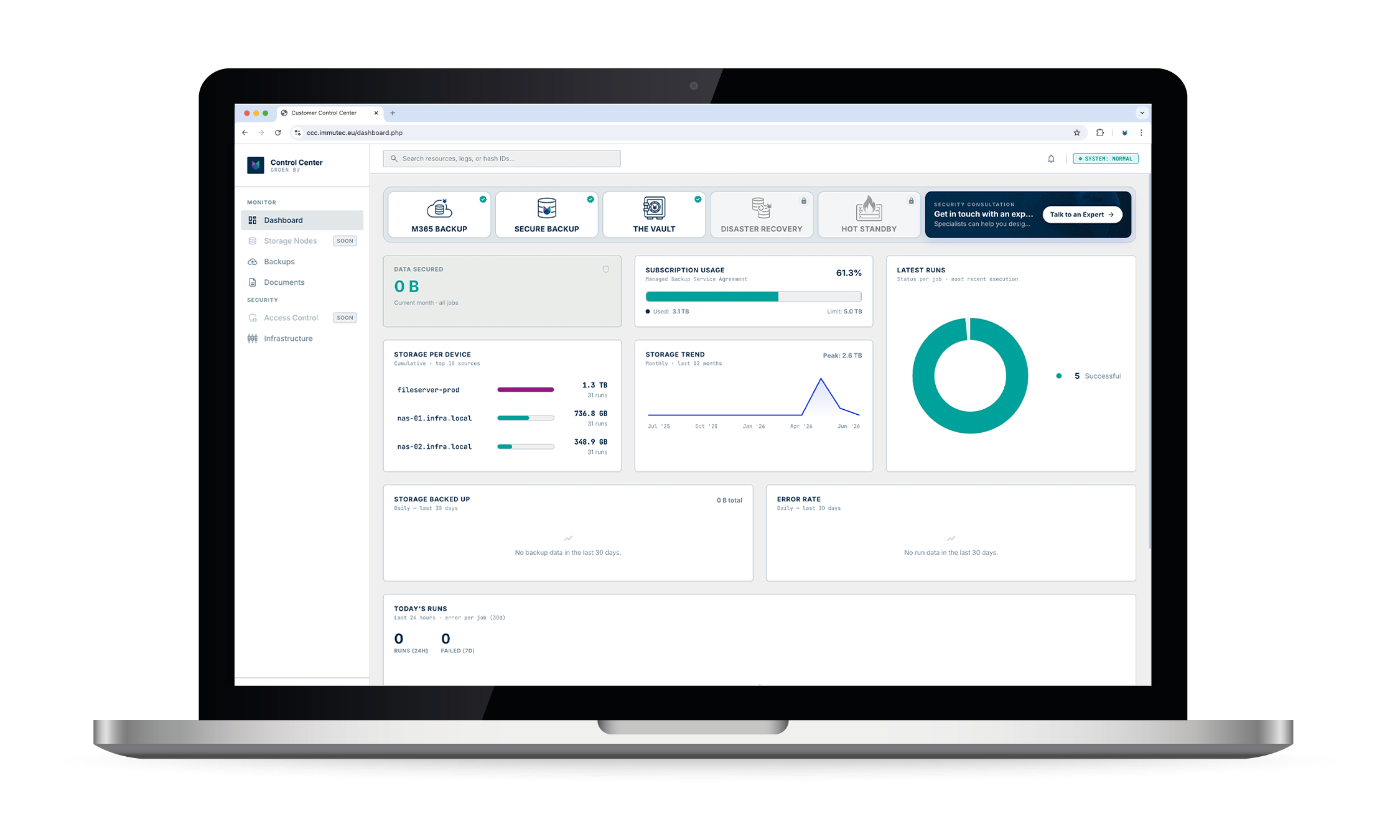
In the Customer Control Center you see your services, your storage and the latest backup runs. Restore reports and recovery plans are ready for your auditor.
How we protect your dataConsidering the cloud for a more stable operation?
Your servers stay where they run best. Our data centre is the cloud behind them: for your backups, as a place to run during an outage, and with a way back.
Disaster recoverySomething else? Send us your question and an engineer will reply.
Keep your supplier for your IT. The question is whether the same party should also keep the backup and check it. Kept apart, a break-in, a mistake or a dispute at one of the two no longer hits both.
Every hour and every task we expect, so you can compare it with what doing it yourself really costs. At FENZI our quote looked more expensive at first for exactly that reason. Once they counted their own internal hours, it was the most cost-effective option.
No. We do backup, recovery and migrations. Your own team or supplier keeps running production IT, and we agree together where the line is.
We set recovery objectives per service. What is realistic depends on the design, the backup frequency, dependencies, capacity and the kind of incident. After a cyber attack we may first need to investigate before we can pick a recovery point.
Bring the list of critical services and how they are backed up today. We’ll turn it into a concrete plan.